TALK TO AN EXPERT
](https://no-cache.hubspot.com/cta/default/2543985/interactive-208415733938.png) ](https://www.bwcprofiles.co.uk/hs/cta/wi/redirect?encryptedPayload=AVxigLKmnOCyF4ytUC6q2gMmxXBO9zEYJSno1i67uB2D0Ce%2FjBpAdhGvpDGlT4r1Li7ndGq8cQBIMthM4hK4PQcxEf2JJiyPHQoSlB1BevR5%2FjbW%2BaNouoU8dhnoVd57w%2BdKpRbwFaPnvLB%2FP%2BLubIKbZCqhUA%3D%3D&webInteractiveContentId=208415733938&portalId=2543985) [ ](https://www.bwcprofiles.co.uk/hs/cta/wi/redirect?encryptedPayload=AVxigLKgZt4BADjhlKkp0g5XHgwxOCFfXbHZ0SpFablfYOXs15bpbOb1WY5Bhm%2BiOTIoCJNsnvB%2FxgkuiQ58evBy3O24n%2FW0wN50CMyXyZl8k1%2BpeS9t%2FhmVP3hV1%2FCk2ngJ5dznMhss%2BfRZXzom0DiOUIA%2F4MBaNuYasQ5BFS4zkapqi0xpH1j7cWDjcK%2FhNVpwt6bqjlPDi8L0CBQeofO7AYkVu8I5eaps5gL%2B&webInteractiveContentId=208415823975&portalId=2543985) ### WHY CHOOSE BWC PROFILES?  #### Extrusion design assistance [FIND OUT MORE](https://www.bwcprofiles.co.uk/our-services/technical-design)  #### Sample & Rapid Prototypes [VIEW MORE](https://www.bwcprofiles.co.uk/our-services/rapid-prototyping)  #### CNC Profile fabrication [View Services](https://www.bwcprofiles.co.uk/our-services/fabrication)  #### POWDER COAT / ANODISE OPTIONS [View Options](https://www.bwcprofiles.co.uk/finishing)  #### STOCK HOLDING & CALL-OFF SUPPLY [Find Out More](https://www.bwcprofiles.co.uk/our-services/stockholding-distribution)  #### UK-based supplier since 1999 [About Us](https://www.bwcprofiles.co.uk/about-us) ## Why Engineers Choose BWC Profiles for Bespoke Aluminium Extrusions If the right standard profile doesn’t exist, we help you design a bespoke section that fits, functions, and manufactures efficiently.  ### Design Assistance That Reduces Cost & Risk Share a sketch, CAD, or a concept, and we’ll shape it into an extrusion that performs and manufactures efficiently. We’ll review extrudability early, before tooling is cut, to prevent redesigns, delays, and unnecessary cost. ### Rapid Prototyping Before You Commit Before you invest in extrusion tooling, de-risk the project with a fast, practical [prototype](https://www.bwcprofiles.co.uk/our-services/rapid-prototyping). We can produce a **3D printed version of your proposed profile** so you can validate the details that matter—overall geometry, interfaces, clearances, fixing points, channels, grooves, and how the profile integrates with surrounding parts.   ### One Supplier for Fabrication, Finishing & Packing Keep your project moving with everything managed in one place, from extrusion through to the finished component. We can handle [**cut-to-length**, **drilling, tapping and milling**,](https://www.bwcprofiles.co.uk/our-services/fabrication-finishing) deburring and other secondary operations so parts arrive **ready for assembly**, reducing your internal workload and supplier coordination. ### MOQ Guidance 350 kilos is our Minimum Order Quantity, however, if you're unable to meet 350Kg of material. It may be possible for us to stock your section, then split the supply across multiple deliveries via our **[Stock Holding & Distribution service.](https://www.bwcprofiles.co.uk/our-services/stockholding-distribution)** ### industries we serve Since 1999, BWC has supplied bespoke aluminium extrusions across a wide range of sectors, including **[Construction & Architecture](https://www.bwcprofiles.co.uk/industries/construction-architectural), [Engineering](https://www.bwcprofiles.co.uk/industries/engineering), [Manufacturing](https://www.bwcprofiles.co.uk/industries/manufacturing), **and** [Shopfitting & Interiors](https://www.bwcprofiles.co.uk/industries/shopfitting-interiors).** ## Start Your Bespoke Profile in Two Simple Ways ### Trouble finding the right profile? ** You Have a Requirement, Not a Design ** Tell us what the profile must do (load, fixings, channels, sealing faces, aesthetics) and we’ll help you develop the section. [TELL US WHAT YOU NEED](https://www.bwcprofiles.co.uk/aluminium-bespoke-profiles#module_177219429473412) or ### Already have a design in mind? **You Have a Drawing** Great! Upload a PDF/DXF/STEP, even if you just have a sketch, and we’ll review feasibility, suggest improvements, and quote. [Send us your design](https://www.bwcprofiles.co.uk/aluminium-bespoke-profiles#module_17721948469379) ## Custom profiles, purpose built to fit your project Bespoke profiles require a custom tool to produce, but allow us to create a section of any design. **For a full explanation, click through the steps below...** ** Introduction ** Function ** Shape ** Tolerances ** Wall Thickness ** Surface Finish ** Alloy Selection ** Conclusion The use of bespoke aluminium extrusions allows designers to create purpose built components that are perfect for their project. Aluminium extrusion is an industrial forming process that is used to produce long profiles of a constant cross-section. This cross-section is shaped by the opening in a steel tool known as a die. Knowing where and how to make minor tweaks and changes will yield significant benefits, not only in extrudability but also with manufacturing and production costs too. It may seem obvious but understanding the function of your profile is key to it’s form and fit being successful in its end use. When designing a profile for extrusion, it’s not just the overall look that needs to be considered, you also need to consider what you want the part to be able to do once produced. Start with a list of 3 questions to ask yourself; - *What is the profiles main functions?* - *What shapes and dimensions will these functions require?* - *Will there be any functional components that will connect to your part/profile?* Once you have an understanding of the essential functions of your profile you will then need to consider the following; There are three general categories that extruded profiles are categorised in: Solid, Semihollow & Hollow.  **Solid profiles** are typically the easiest to extrude as they are usually the least complex. You can produce a variety of forms with a solid profile as long as it’s cross-section doesn’t have any voids. A **Semihollow **profile is defined by it’s tongue ratio as it partially encloses a void. A semihollow profile will be defined mathematically by comparing the area of the partially enclosed void to the size of the gap (to the mathematical square of the gap size). If that ratio is larger than a pre-defined number, the shape is classified as semi-hollow; if the ratio is smaller, the shape is considered a solid. **Hollow profiles **contain a void or maybe even multiple voids on a single profile. This is the most basic description of these three categories, there are other factors which need to be taken into consideration when deciding whether your profile is one of the above shapes. The less complex and easier to extrude a profile is, the more likely it will cost less than a profile that is complex and that will take longer to go through the extrusion process. When it comes to designing profiles for extrusion, understanding the end use of the profile is essential. Dimensional tolerances are absolutely critical, especially if the profile is going to have mating components. Tolerances will cover the characteristics of the profile such as the straightness, flatness, twist, thickness, angles, contours, corners and fillet radii. It’s fairly easy to achieve standard dimensional tolerances but can be considerably difficult to achieve certain tolerances if the profile is more complex. It is impossible to cover all of the standard dimensional tolerances that meet all situations which is why it’s recommended to talk to us about the tolerances that can be achieved first. You can design a profile with dimensional tolerances that go beyond standard tolerances, these are called "special tolerances". You will need to check with the us before going through the manufacturing process, special tolerances can be achieved but it's likely to end up being a more costly and timely process. It's more cost effective if you can design your profile with a minimum requirement for special tolerances.  From a cost perspective, having a uniform wall thickness with a minimum aluminium thickness that meets the structural requirements is incredibly beneficial. It’s easier to extrude and costs less than a more complex profile. Considerably uneven wall thicknesseses (especially if adjacent) can cause problems during the extrusion and cooling process which can lead to the profile not being able to hold its desired shape & also creates blend or witness lines which will become usually apparent after finish. You should always avoid adjacent wall thicknesses that have a higher ratio than 2 -1 and use rounded corners to transition from walls which have different thicknesses. This is to help ease the flow of aluminium. Factors that can determine minimal wall thickness; **Heat Generation – **This is a key factor. When you push aluminium through a die, it produces heat. The larger the degree of forming, the more heat that is generated. When temperatures are high it can create problems on the extrusions surface in the form of pick ups and cracks. **Tolerances **– Tolerances are affected by wall thicknesses, dimension size, location, profile type (solid or hollow) alloy used, cross section & the parts application. To get a better understanding on what tolerances should be used, contact us [here](https://www.bwcgroup.co.uk/contact). **Choice of Alloy – **Your choice of alloy will determine the minimum achievable wall thickness. When an alloy has a high content of alloying elements, it’s harder to extrude than alloys with a lower content, thus requiring thicker walls. **Cross Section Complexity – **Typically, it’s a lot easier to produce thin walls that are in simple sections as opposed to thicker walls in complex sections. Also, it’s worth considering that cavities are harder to fill in hollow sections with several channels. Speak to us for more information. When designing your profile, It’s favourable to consider symmetry and constant wall thickness as it contributes to better flow characteristics. Aluminium offers many options for surface finishing such as linishing finishing, satin finishing and buffing. Profiles can also be finished by clear or coloured anodising, powder coating & painting. Knowing what finish your profile will require in the design phase can be important, often people overlook the dimensions a finish can add to your profile, although they can be very minor, it can lead to critical errors happening further down the line. Talk with us [here](https://www.bwcgroup.co.uk/contact) to discuss what your finishing options and the dimensions it can add to your profile. However, extrusion dies can be designed to orient the shape to protect the surface during the extrusion process, again, it’s worth talking to us about what finish you want to go for and what options you have available. Your alloy choice depends on your profiles need and end use, there is a wide variety of alloys and tempers that are available which can be used to create your profile. Understanding what strength your profile will need e.g. the weldability, forming characteristics, finish, machinability, corrosion resistance, etc. will be dependent on the alloy you choose to extrude your profile, some alloys are used more frequently than others. Around 75% of alloys used are from the 6xxx-series, the most popular alloys are 6063, 6060 & 6082. [Find out more about selecting the right alloy here.](https://www.bwcprofiles.co.uk/extrusion-academy/choosin-the-right-alloy) Increased profile complexity ultimately raises the overall cost as it can reduce production speed and cause other complications such as die failure and extended quality control. However, that doesn’t mean it isn’t possible to create a complex profile, these are just considerations to make before committing to the cost of your die being produced and your profile going through the manufacturing process. Although there are many considerations to take into account, designing with aluminium gives you a lot of freedom with creativity and infinite opportunities of shapes and extrusions. ## Bespoke Aluminium Profile FAQs What information do you need to quote a bespoke aluminium profile? To quote accurately, we ideally need a **drawing** (PDF/DXF/STEP), target **alloy**, required **finish** (mill finish, anodised, powder coated), **cut lengths**, and any **secondary operations** (drill/tap/mill, assembly, packaging). Please also share expected **order quantity** (MOQ/annual usage), application details (loads, environment, cosmetic faces), and any critical **tolerances**. If you don’t have a drawing yet, a sketch and requirements are enough to start. What’s the difference between standard and bespoke extrusions? **Standard profiles** are off-the-shelf shapes that already exist (angles, channels, box section, etc.)—fast to source and ideal when they meet your needs. **Bespoke extrusions** are designed specifically for your application, using a dedicated die/tool. This unlocks better fit and function, fewer parts, faster assembly, and lower total cost in volume—especially when you build in features like fixing points, channels, sealing lands, or cable routes. What tolerances can be achieved on extruded profiles? Extrusion tolerances depend on **profile size, complexity, wall thickness, alloy, and die design**, and they’re not the same as precision machining tolerances. We’ll advise practical, achievable tolerances early—highlighting which dimensions are critical and where it’s smarter to hold a tighter tolerance through **secondary machining**. If your assembly requires very accurate interfaces, we can plan the extrusion plus CNC operations together so the final component meets fit and performance requirements. Can you supply fabrication and finishing as well as extrusion? Yes. Alongside bespoke extrusion, we can coordinate **cut-to-length**, **drilling, tapping and milling**, deburring and other secondary operations so parts arrive **assembly-ready**. We can also support finishing requirements such as **powder coating** or **anodising**, with protection and masking where needed. Handling extrusion, fabrication and finishing together reduces handoffs, speeds up your workflow, and helps ensure the final dimensions still fit once coatings and processing are applied. Which alloys are most common for bespoke profiles? For aluminium extrusions, **6xxx series alloys** are commonly specified because they balance strength, corrosion resistance, extrudability and finish quality. The right choice depends on what matters most—mechanical performance, surface appearance, machining characteristics, or how the part will be used outdoors. We’ll recommend an alloy based on your functional requirements and finishing plan, and we’ll factor in any post-processing (machining, anodising, powder coating) so the final part performs as intended. Can you help redesign a profile to reduce die cost and production issues? Absolutely. Many issues can be avoided by refining the profile **before tooling is cut**. We’ll review wall thickness, radii, symmetry, voids, and fine details that affect metal flow and die complexity—then suggest adjustments that improve extrudability and consistency. This can reduce tooling risk, improve yield, and avoid problems like distortion or difficult-to-hold dimensions. If needed, we’ll also recommend where to machine critical features rather than forcing them into the extrusion. Do you provide prototypes before production? Yes. Where it helps de-risk the project, we can support **rapid prototyping**—often via a **3D printed profile**—to validate fit, interfaces, clearances, fixing points and overall geometry before committing to tooling. Prototyping is especially useful when the profile integrates with multiple components or installation tolerances are tight. Once you’re happy, we carry the validated design into die manufacture and production planning, so the extrusion stage starts from a proven baseline. 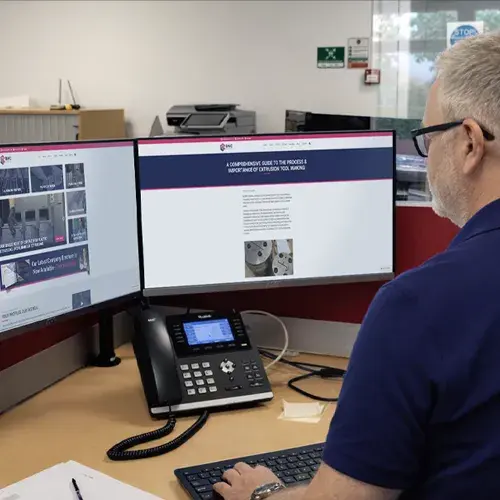 ## A must-read blog: A Comprehensive Guide to the Process & Importance of Extrusion Tool Making In our blog, **“A Comprehensive Guide to the Process & Importance of Extrusion Tool Making”**, we explain the role tooling plays in **profile accuracy, surface finish, consistency, and production efficiency**, plus the key steps involved in turning a profile design into a working tool. It’s a practical read for engineers, buyers, and designers who want fewer surprises when moving from concept to production. [![Read 'Guide to the Process & Importance of Extrusion Tool Making' Blog