lighting extrusions & Profiles
LED Heat Sinks, Housings & Diffusers
where extrusion adds value in lighting applications
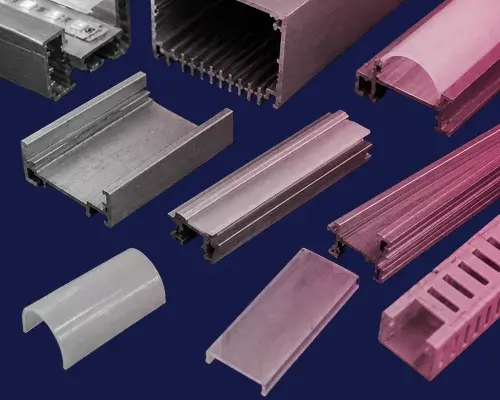
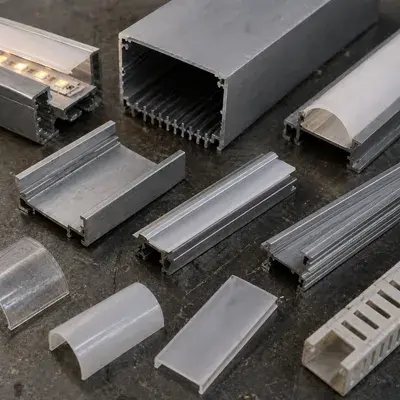
Lighting solutions require materials that offer efficient heat dissipation, durability, and aesthetic appeal for various applications. Aluminium is ideal for LED heat sinks, housings, and reflective components that require excellent thermal conductivity. Plastic is commonly used for diffusers, protective covers, and flexible tubing for wiring systems.
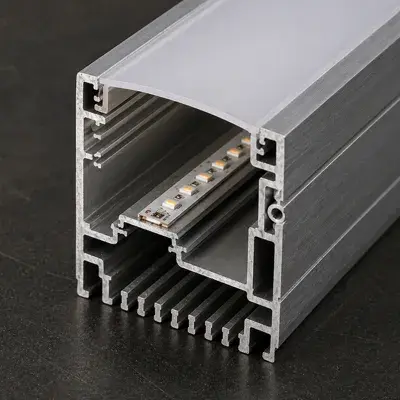
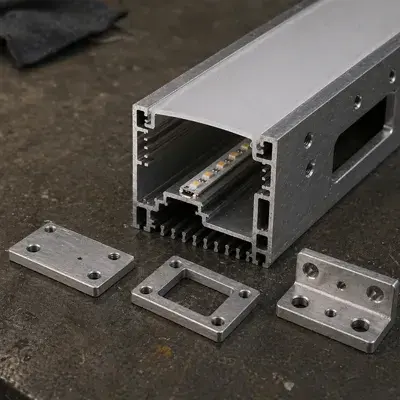
Where extrusion adds value is in the interfaces and thermal paths that must repeat at scale: consistent heat transfer from LED board to the sink, straight profiles that stay true over length, clean cover/diffuser fits, and defined reference faces for machining and inspection. Extrusion delivers repeatable section geometry and allows functional details such as mounting lands, cover tracks, cable channels, lens/diffuser retention features and protective edges to be integrated into one profile, so machining is focused only where it drives fit, alignment and assembly performance. The best results come when extrusion is treated as a complete route: stable profile design, realistic tolerances focused on functional interfaces, controlled machining, and a finishing/handling plan that protects critical and cosmetic faces through repeat supply.
Why Choose BWC Profiles for Lighting Extrusions
Manufacturers choose us when they need stability, repeatability and a clean production route. We don’t just supply an extrusion, we support the outcome: a profile that runs stable, machines cleanly, finishes predictably, and assembles the same way across batches.
DESIGN ASSISTANCE
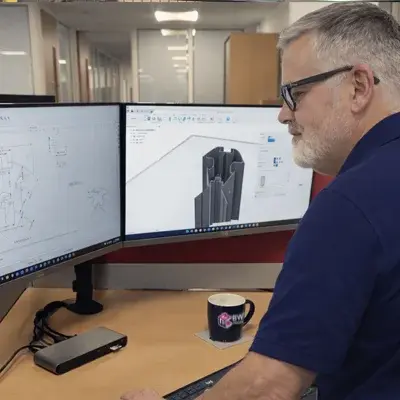
Design assistance for stable, extrudable profiles without changing function.

SAMPLES & PROTOTYPES
Prototype support to check fit, detail and function before production.
CNC PROFILE FABRICATION
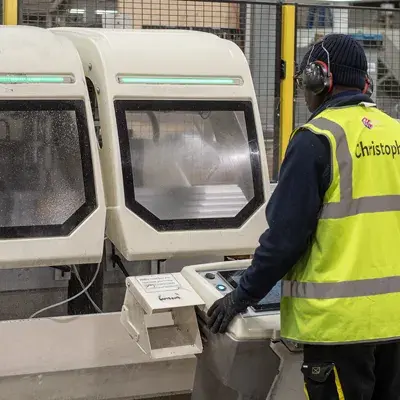
Practical tolerance strategy and inspection focus to control cost drivers.

QUALITY ASSURANCE
Quality control for accurate, consistent profile production every time.

READY, REPEAT SUPPLY
We supply the support you need for all your phased releases, repeat orders.
UK SUPPLIER SINCE 1999
We are proud experts with experience in aluminium and plastic extrusion & profiles
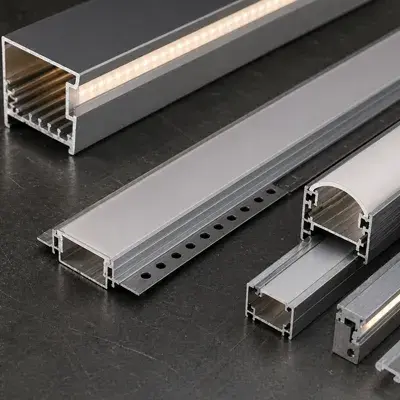
what lighting assemblies need
Lighting products are judged instantly: they must look clean, assemble square, run reliably, and manage heat properly over their lifetime. Problems usually don’t start with the concept, they start with variation: housings that twist so diffusers don’t seat evenly, mounting holes that drift so brackets fight the build, cover tracks that vary so clips either rattle or crack, and thermal interfaces that aren’t controlled so performance changes from batch to batch.
Extrusion works because it gives you long-length repeatability and the ability to engineer the functional behaviour into the section. That means fewer add-on parts, fewer adjustments on the bench, and a clearer route to a consistent finished product. Lighting assemblies often depend on more than the section alone. The important details are how the profile controls line, fit, thermal contact, access, integration and finish across the full build.
what extrusion supports
For the lighting industry, our expertise and experience in extrusion supports:
- Repeatable thermal geometry for LED heat sink performance (design dependent)
- Stable long-length housings and channels that build straight and clean
- Integrated features that reduce bracketry and fasteners
- Defined reference faces for repeat machining and inspection
- Aesthetic surfaces and edge detailing designed for finishing and handling
lighting profile applications
Lighting covers everything from linear architectural profiles to industrial luminaires and decorative housings. Across all of them, the common requirement is repeatability: controlled thermal behaviour, controlled interfaces, and a clean assembly route.
Common application areas include:
- LED heat sink profiles and thermal management sections
- Luminaire housings, carriers and mounting rails
- Linear lighting channels and architectural lighting profiles
- Reflector carriers and optical support sections
- Diffusers, lens covers and protective trims (plastic)
- Cable management and wiring protection profiles (plastic)
typical profile features
The goal is to build ‘fits every time’ into the section so assembly doesn’t rely on adjustment. In lighting, that also protects aesthetics: consistent diffuser seating, tight seams, straight sightlines and predictable end closures.
Common features include:
- Mounting lands/bosses sized for drilling/tapping or inserts
- Controlled cover tracks / diffuser retention features
- Cable channels and wiring management features
- Internal rails/ledges for PCB/driver location and repeatable assembly
- Controlled joint lands and end interfaces for repeatable closure after cut/machine
- Reference faces for repeat machining set-up and inspection
- Cosmetic faces planned for finishing, with handling-friendly edges
- Clip/interlock features to reduce separate brackets and fasteners
tolerances & Inspections
Lighting gets expensive when everything is held tight “just in case” or when cosmetic and functional requirements aren’t separated. The smarter approach is to control only what drives performance, assembly, and appearance — and verify those areas consistently.
Focus tolerance and inspection on key features: thermal interfaces, diffuser fits, joint faces, and mounting locations. Everything else can remain more open to protect yield and reduce cost, while finishing maintains visual quality.
What this means:
- Define and control functional interfaces
- Tighten tolerances only where needed
- Keep non-critical geometry open
- Control straightness/twist only where it matters
- Inspect from reference faces and critical dimensions
machining strategy
Extrusion provides the base geometry, with machining applied only where tighter control is needed — typically bracket faces, hole patterns, end closures, connector openings, and key interfaces for diffuser fit, PCB location, and joint closure.
A controlled strategy improves repeatability: with defined reference faces and planned fixturing, every part is machined from the same basis, reducing variation across batches.
Typical operations include:
- Drill/tap patterns for assembly
- Slots and cut-outs for connectors and access
- End machining for clean, repeatable closure
- Reference faces for fixturing and measurement
- Interface faces where alignment matters
The goal: stable base geometry with targeted machining — not CNC everything.
finishing, handling, and protection
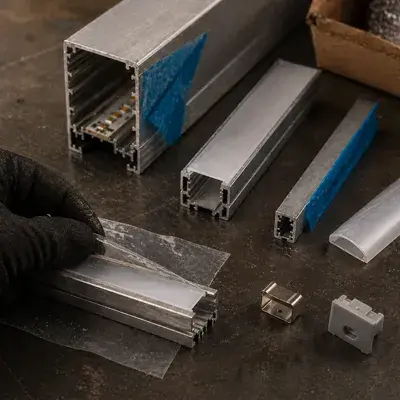
Lighting is highly visible. Finishing is often essential for appearance and corrosion resistance, but it can also create fit issues if not planned early; coating build-up can affect diffuser seating, clip fits and joint closure. Handling damage can also ruin cosmetic faces, so protection through batching and transit matters.
Our planned finishing is around:
- Coating build-up on mating/locating and clip/track interfaces
- Masking where controlled fit or electrical contact is required
- Protective films and packaging where cosmetic faces must be preserved
- Agreeing which faces are cosmetic vs functional early so finishing doesn’t compromise fit
design for extrusion guidance
Good lighting profiles are stable, extrudable, and easy to machine consistently. Stability protects both assembly and appearance: straighter sight-lines, cleaner joints, and more predictable diffuser fits.
At BWC Profiles, we have key design rules we advise on:
- Balance wall thickness to reduce twist and improve stability over length
- Use internal radii (avoid sharp internal corners) to support metal flow and die life
- Avoid sudden thickness changes that increase distortion risk
- Plan CNC access early for holes, slots, pockets and interface faces
- Design reference faces that make fixturing repeatable
- Keep critical dimensions tight only where they drive function; leave non-critical geometry open to protect yield and cost
secondary operations and supply support
A lighting component is rarely ‘as extruded’. The route needs to be predictable: consistent cutting, deburring standards, machining datum strategy, finishing coordination, and protection/packaging, done the same way batch after batch.
At BWC Profiles, support typically includes:
- Cut-to-length, deburr and edge breaks
- CNC machining (drill/tap/slots/pockets) focused on interfaces
- Finishing coordination (application dependent)
- Protective films, packaging and repeat batching for ongoing supply
talk to bwc profiles
If you’re developing a lighting product and need custom aluminium or plastic extrusions for LED heat sinks, housings, diffusers, covers or mounting profiles, send us your drawings and requirements. We can support practical profile development for lighting systems that need effective thermal management, controlled light diffusion, clean integration and repeatable results.
quote requirements
To quote accurately, we need to understand the profile, its function, and any machining, finishing or supply requirements, not just the section shape.
Helpful quote inputs include:
• Section drawing or CAD model
• Material grade, if known
• Critical dimensions, fits or tolerances
• Any machining requirements
• Finishing requirements
• Estimated quantities
• Application details
What Our Customers Say
"We are very pleased with BWC and would recommend."
"Excellent. Professional, knowledgeable and extremely helpful."